
Why Everyone Thinks They're the Normal One
Nov 01, 2026
Somewhere in the world, two people are currently having a very serious disagreement about how to load a dishwasher.
One believes the forks should point upward. The other insists they should point downward.
Both have reasons. Both have evidence.
And somewhere nearby, a third person is quietly wondering why anyone is arranging the silverware at all when you could simply throw everything in and close the door.
Humanity is a fascinating species.
We disagree about whether arriving five minutes early is polite or awkward, whether leaving a text unanswered for three hours is perfectly normal or grounds for a missing-person investigation, and whether the toilet paper should hang over or under the roll. Literally as I write this I strongly feel there is a correct answer to all of these, which just proves my point.
And somehow, despite the astonishing variety of human experiences, preferences, cultures, and personalities, most of us manage to arrive at a remarkably similar conclusion:
"The way I do things is pretty normal."
Other people, meanwhile, have some explaining to do.
But psychology has uncovered something rather interesting about this tendency.
It turns out we're not simply attached to our preferences.
We often genuinely expect other people to share them.
And when they don't? Well, that's when things get interesting...
Your Brain Has Mistaken Familiar for Universal
Think about something you've been doing the same way for twenty years.
Maybe you wash dishes immediately after dinner, prefer making plans several days in advance, or think "I'll let you know how I feel that day" is a perfectly reasonable response to an invitation.
Whatever it is, your approach feels natural.
Not necessarily superior.
Just obvious.
And here's the peculiar part: because your own habits are so familiar, it can be surprisingly difficult to recognize that someone else's habits feel equally obvious to them.
Psychologists have a name for one piece of this puzzle.
It's called the false-consensus effect.
Essentially, people tend to estimate that their own choices, opinions, and behaviors are more common than people who make different choices estimate them to be.
Notice the distinction.
It doesn't necessarily mean everyone believes they're in the majority.
It means our own choices influence what we expect other people to choose.
And in 1977, three researchers decided to investigate this phenomenon with an experiment that involved asking college students to do something spectacularly awkward.
The Experiment With the Enormous Sign
Picture yourself walking across a university campus.
You're on your way to class, perhaps thinking about lunch or an assignment you probably should have started yesterday.
A researcher approaches you with a proposition:
Would you be willing to walk around campus wearing a large sandwich-board sign advertising a restaurant?
The sign says:
EAT AT JOE'S.
For thirty minutes.
In public.
Where people can see you.
For science.
Now, before you decide, consider this question:
What percentage of other students do you think would agree to wear the sign?

In a classic series of studies, psychologists Lee Ross, David Greene, and Pamela House explored how people's own choices influenced their estimates of what others would do.
In one version, participants considered wearing a sandwich-board sign with a message such as "Eat at Joe's" or "Repent." In another, students faced an actual request to wear a sign.
And the results were revealing.
Among participants considering the "Eat at Joe's" scenario, those who said they would wear the sign estimated, on average, that about 65% of their peers would agree.
Those who said they wouldn't wear it estimated that only about 31% would agree.
Same campus.
Same sign.
Very different expectations about what other people would consider reasonable.
The students weren't simply describing their own preferences.
Their preferences were influencing their predictions about everyone else's.
And the researchers found another interesting pattern.
Participants also tended to interpret people who made the opposite choice as more distinctive in their personality.
If you thought wearing the sign was perfectly reasonable, someone who refused might seem unusually uptight.
If you thought wearing it was ridiculous, someone who agreed might seem unusually eager for attention.
Your own choice became the reference point.
And the other person's choice became something that needed explaining.
Which brings us back to the dishwasher.
Because perhaps the most interesting part of this phenomenon isn't that we expect people to agree with us.
It's what we assume about them when they don't.
The Particularly Annoying Problem of Being Certain
There's another psychological concept that makes this even more interesting.
It's called naïve realism.
And despite the name, it doesn't mean you're naïve or particularly bad at understanding reality.
It describes a tendency to experience our own perceptions and interpretations as straightforward reflections of how things actually are.
In other words, we don't usually walk around thinking:
Here is my highly personal interpretation of this situation, shaped by my upbringing, experiences, expectations, and the fact that I haven't eaten lunch.
We think:
Well, obviously.
And that little word can cause an extraordinary amount of trouble.
Because if you're simply seeing things as they are, then someone who disagrees must be missing something.
- Perhaps they don't have all the information.
- Perhaps they haven't thought it through.
- Perhaps they're biased.
- Perhaps they are, regrettably, the sort of person who loads a dishwasher incorrectly.
When people disagree with us, it's easy to assume that the disagreement reveals something about them, rather than considering how two people might be interpreting the same situation differently.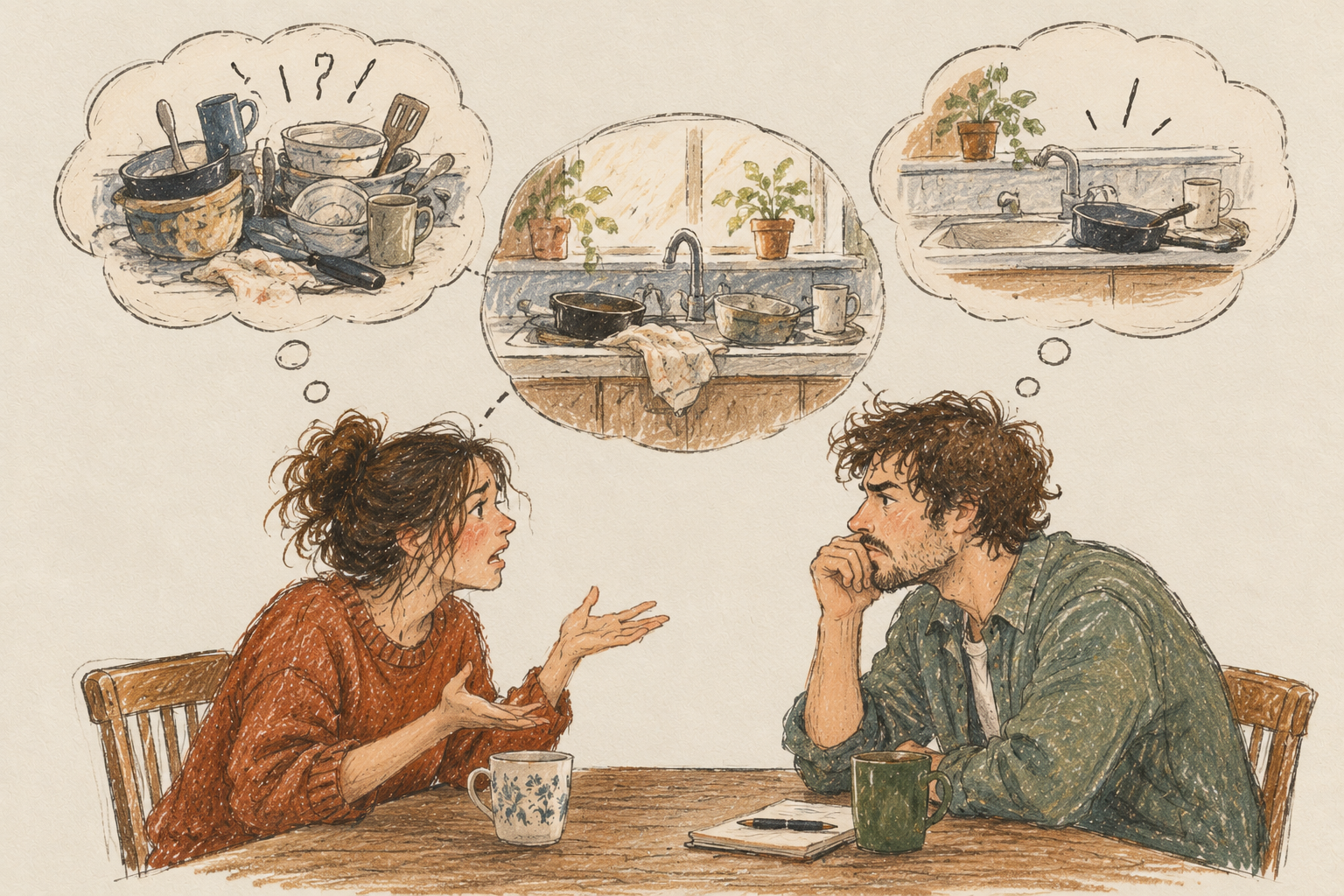
And here's the particularly inconvenient part:
The other person may be just as convinced that they're the one seeing things clearly.
Two people can walk away from the same conversation believing they were perfectly reasonable and the other person was being difficult.
Both can remember the interaction differently.
Both can feel misunderstood.
And both can be genuinely confused about how the other person arrived at such an obviously incorrect conclusion.
If this sounds familiar, congratulations. You've encountered humanity. 💛
The Rules Nobody Remembers Inventing
But where do all these different ideas of normal come from?
- Sometimes they're simply preferences.
- Sometimes they're practical habits we've developed over time.
- And sometimes they're rules we absorbed so early that we barely remember learning them.
Consider something as ordinary as visiting someone's home.
In one household, guests are expected to make themselves comfortable. Open the refrigerator. Grab a drink. Put your feet up.
In another, opening someone's refrigerator without asking would be an astonishing act of social confidence.
Neither household necessarily sat down and wrote a constitution.
The rules just developed.
Children observed how adults behaved. Families repeated familiar routines. People learned what counted as polite, rude, considerate, or strange.
And eventually, those expectations became so familiar that they stopped feeling like expectations.
They started feeling like common sense.
The same thing happens with communication.
- One person grows up in a family where disagreements are discussed immediately, often loudly, and everyone is perfectly cheerful by dessert.
- Another grows up in a family where people need quiet time before discussing anything difficult.
Now imagine those two people trying to resolve an argument.
One thinks, Why won't you just talk to me?
The other thinks, Why won't you give me a minute to think?
Both might genuinely believe they're trying to handle the situation responsibly.
And both might interpret the other's behavior as evidence that they don't care.
That's the part worth paying attention to.
Because once we've decided what someone's behavior means, we can become remarkably confident about their intentions.
Even when we've never actually asked.
The Difference Between What Happened and What It Meant
Let's try a little thought experiment.
Imagine you send a friend a message.
They read it. They don't respond. Six hours pass.
What happened?
Well, that's straightforward.
Your friend hasn't responded to your message.
But what does it mean?
That's where things become considerably less straightforward.
- Perhaps they're upset with you.
- Perhaps they're busy.
- Perhaps they opened the message while standing in a grocery store and immediately forgot it existed.
- Perhaps they prefer responding when they have enough time to give a thoughtful answer.
- Perhaps their phone is currently somewhere beneath a pile of laundry, where it has established a small independent civilization.
The observable event is the same.
The possible explanations are wildly different.
And yet, depending on your experiences and expectations, one explanation might feel far more obvious than the others.
This doesn't mean every explanation is equally likely.
And it certainly doesn't mean you should ignore patterns of inconsiderate behavior.
It simply means there's a difference between what someone did and the story we tell ourselves about why they did it.
What Would Make That Make Sense?
Here's a question I've been thinking about:
What would someone have to believe, know, or have experienced for that choice to make perfect sense to them?
It's a wonderfully strange question because it asks you to temporarily stop evaluating someone's decision from inside your own perspective.
Instead, you try to reconstruct theirs.
Let's return to our dishwasher enthusiasts.
One person insists that forks should face upward because they believe the utensils get cleaner that way.
The other insists that forks should face downward because they're concerned about sharp points sticking up.
Suddenly, the disagreement looks different.
They're not necessarily arguing because one person is careless and the other is controlling.
They might simply be optimizing for different things.
Cleanliness versus safety.
And once you understand that, you can actually discuss the underlying concern.
Perhaps your dishwasher cleans equally well either way.
Perhaps the manufacturer has a recommendation.
Perhaps you discover that the third person, who throws everything into the basket like a tiny metallic avalanche, has been achieving excellent results for years.
I wouldn't count on that last one, been there, done that, broke a dishwasher.
But stranger things have happened.
The point is that understanding someone's reasoning gives you more useful information than simply deciding they're wrong.
And this works with bigger disagreements, too.
If someone approaches a decision differently from you, what are they prioritizing?
What experiences shaped that priority?
What information might they have that you don't?
What information might you have that they don't?
Sometimes you'll discover a misunderstanding.
Sometimes you'll discover a difference in values.
And sometimes you'll discover that you understand their reasoning perfectly well and still disagree.
Which brings us to an important distinction.
Understanding Isn't the Same as Agreeing
I want to be careful here, because there's a version of this idea that can become rather unhelpful.
It's the suggestion that if we just understood everyone better, we'd stop disagreeing.
I don't think that's true.
People can understand one another beautifully and still have genuinely incompatible preferences, needs, or beliefs.
A behavior can be genuinely inconsiderate, a demand can be unreasonable, and understanding why someone acts a certain way doesn't mean you have to accept it. There are plenty of situations where you can understand someone's perspective perfectly well and still need to say no.
Curiosity doesn't require you to surrender your judgment.
It simply gives your judgment better information to work with.
You can understand why someone wants something without agreeing to provide it.
You can recognize that a person's experiences shaped their perspective without treating their conclusions as automatically correct.
And you can acknowledge that your own perspective has blind spots without assuming that every disagreement is your responsibility to resolve.
The goal isn't to become endlessly accommodating.
It's to become a little more accurate.
Which, considering how confidently our brains can invent explanations for other people's behavior, seems like a worthwhile ambition.
A Tiny Experiment in Being the Weird One
Here's something you can try this week.
Find one small thing you consider completely normal.
Not a deeply held moral belief or an important boundary.
Something ordinary.
The way you organize your kitchen.
How early you arrive for appointments.
Whether you prefer people to call before visiting.
How you decide when it's time to replace a towel.
Now ask someone else how they do it.
And here's the important part:
Don't tell them your answer first.
Just ask.
You might discover that they do exactly what you do.
You might discover that they have an entirely different system.
Or you might discover that they've never given the subject a moment's thought, which is frankly a little unsettling when you've spent years defending your preferred method.
If their answer surprises you, resist the urge to explain why your method is better.
Instead, ask:
“Oh, interesting. How did you end up doing it that way?”
You may learn something practical.
You may uncover a funny family tradition.
You may discover a preference you never knew existed.
And occasionally, you may realize that your supposedly universal approach is actually a very specific habit inherited from one particular household.
Which is a lovely little reminder that the world is much bigger than the version of it we've personally experienced.
The World Is Full of People Who Think You're Strange
Somewhere out there is a person who thinks your favorite food is disgusting.
Someone who finds your ideal vacation exhausting.
Someone who would look at your carefully organized closet and wonder why you've made getting dressed so complicated.
And someone who would consider your perfectly reasonable approach to dishwasher loading an act of domestic sabotage.
They're not necessarily right.
But here's the interesting thing.
You are somebody else's unusual person.
Your habits, preferences, and assumptions aren't the default settings for being human.
They're one particular combination of experiences, circumstances, and choices.
And so are everyone else's.
I find that rather delightful.
Because it means the next person who completely baffles you might not be a problem to solve.
They might be an opportunity to discover an entirely different way of seeing something familiar.
You don't have to adopt their perspective. You don't even have to like it, honestly.
But the next time you catch yourself thinking, “Who on earth does it that way?”
Try adding one more question:
“I wonder why.”
You might be surprised by the answer.
And if nothing else, you can always go home and load the dishwasher correctly.
Whichever way that is.