
What Happens When You Notice One Color All Day?
Oct 08, 2026
I have a small experiment for you!
Tomorrow morning, choose a color.
Any color. Yellow, red, purple, that particular shade of green that makes you want to buy an unnecessarily expensive velvet sofa.
Then spend the day looking for it. That's it.
No special equipment. No elaborate instructions. You don't even have to write anything down.
Just pick a color and see what happens.
Because there's a decent chance that by lunchtime, you'll start wondering whether someone has been secretly decorating the world while you weren't looking.
Suddenly, Everything Is Yellow
Let's say you choose yellow.
You leave the house and notice a yellow car. Then a yellow flower growing through a crack in the sidewalk. Someone walks past wearing mustard-colored shoes.
At the grocery store, there's a display of lemons you probably would have ignored yesterday.
And then you notice the yellow lettering on a sign you've walked past approximately four hundred times.
At some point, you may begin to wonder:
Has everything always been this yellow?
Well, yes. Probably.
But something has changed (and it isn't the lemons!)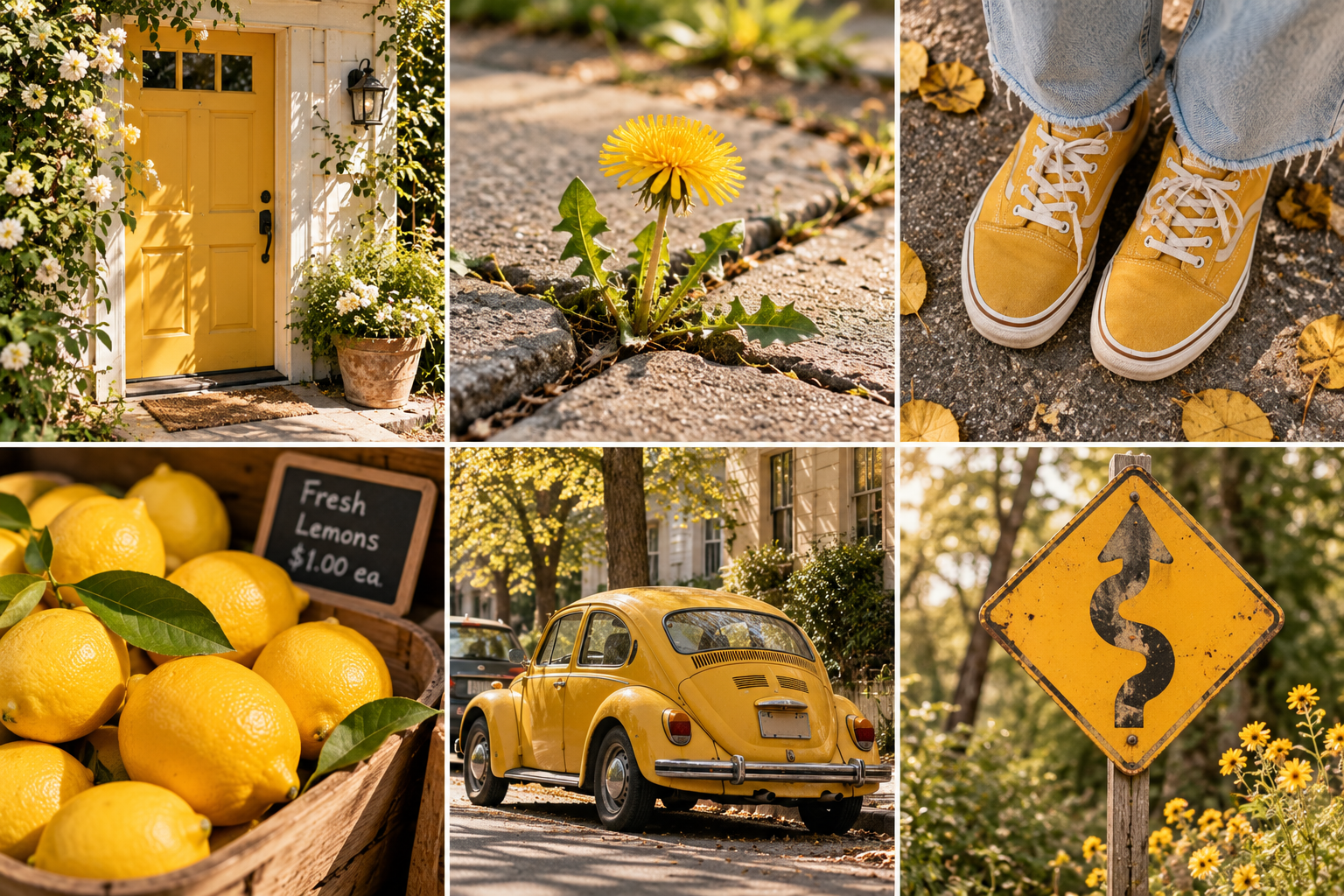
Your Brain Has an Editor
Here's something strange about being human: you're surrounded by far more information than you can consciously pay attention to.
Colors. Sounds. Movements. Textures. Faces. Objects.
Your brain has to prioritize.
Otherwise, buying a carton of milk would require processing every label, every floor tile, every passing conversation, and the precise shade of every cereal box in the building.
We'd never make it out of the grocery store.
Psychologists call one part of this process selective attention.
Your attention favors certain information while other details receive less conscious processing.
And when you deliberately choose something to look for—say, yellow objects—you make that information more relevant to your current goal.
Suddenly, yellow things have a better chance of catching your attention.
Your brain isn't showing you everything. It's showing you a highly edited version of reality, and if you didn't know...the editor has opinions.
The yellow objects didn't necessarily become more common.
You just started noticing more of them.
The Strange Case of the Suddenly Everywhere Thing
Have you ever learned a new word and then heard it three times in the same week?
Or discovered an unusual type of car and suddenly started seeing it everywhere?
There's a name for that experience: the frequency illusion (sometimes called the Baader–Meinhof phenomenon).
Once something catches your attention, you may notice it more frequently. And when you remember those encounters, it can feel as though the thing itself has suddenly become more common.
Attention and memory both contribute to the impression.
The world hasn't necessarily changed. Your awareness of one small part of it has.
Although I do enjoy imagining that somewhere there's a committee responsible for dramatically increasing the number of yellow cars whenever someone notices one.
Very efficient people, apparently.
Now, the color experiment isn't a perfect demonstration of the frequency illusion. You're deliberately searching for something rather than spontaneously noticing it everywhere after an initial encounter.
But the two experiences share an interesting ingredient: what matters to your attention influences what you notice.
And that makes this little experiment surprisingly fun.
Artists Have Been Playing With This for AGES
Here's where things get even more interesting.
Artists and designers spend a remarkable amount of time learning to notice things that other people overlook.
Not necessarily because they have fundamentally different eyes, but because observation is something they practice.
- A painter might notice that a white wall isn't really white in the afternoon. It contains soft blues, reflected greens, and warm patches of sunlight.
- A photographer might notice that a red umbrella becomes the most visually prominent object on an otherwise gray street.
- And someone studying color might discover that the same shade looks surprisingly different depending on which colors surround it.
Artist Josef Albers famously explored these relationships in his work and teaching, demonstrating how strongly our perception of color depends on context.
A color doesn't exist in our experience entirely on its own, its neighbors have opinions, too.
So while you're hunting for your chosen color, try noticing something else:
Does it look different depending on where you find it?
A yellow flower against dark soil might seem almost luminous.
The same yellow on a pale wall might barely attract your attention.
And a bright yellow raincoat on a gloomy afternoon?
Practically a public service.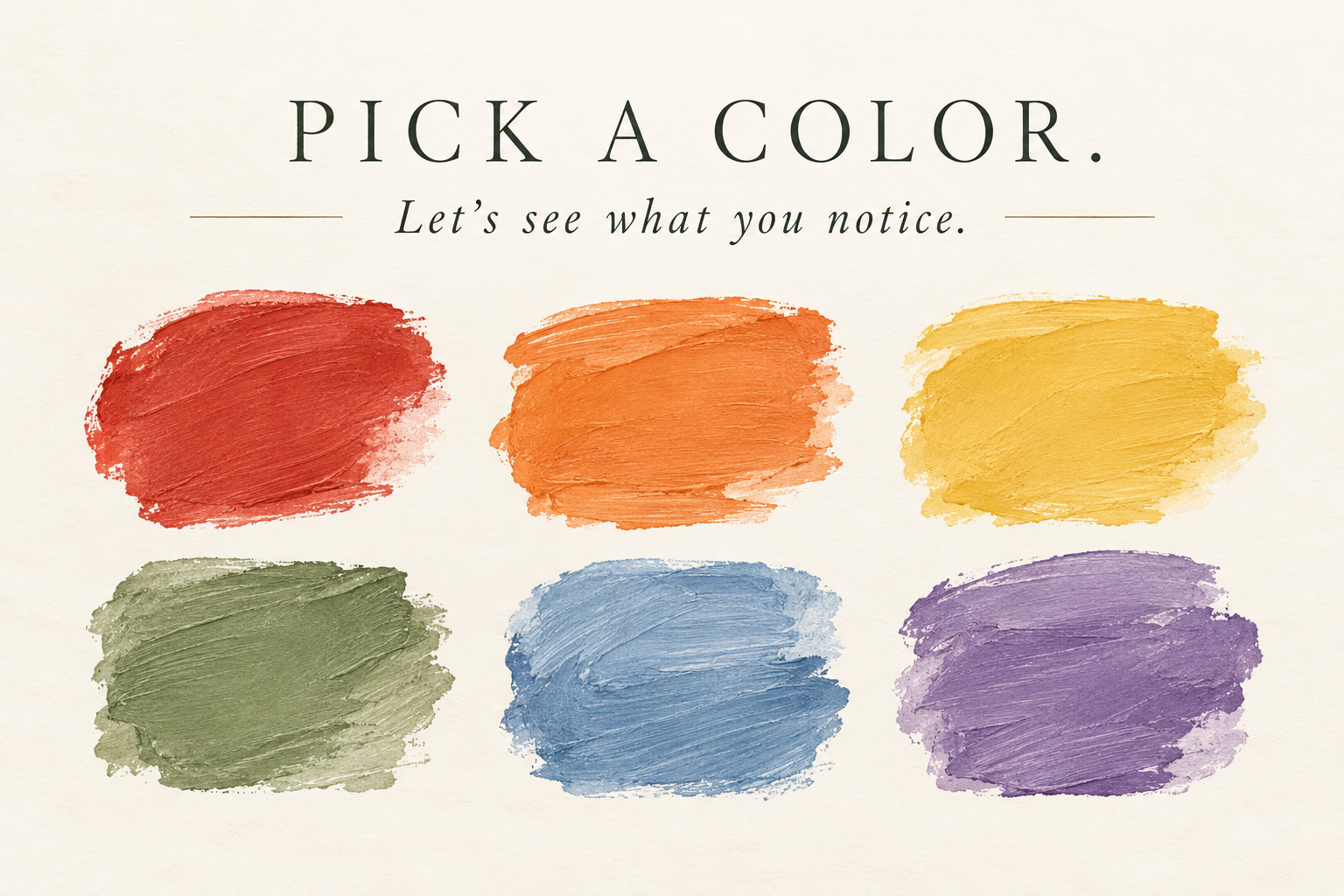
Your Tiny Experiment
Ready to try?
Step 1: Choose your color.
I'd recommend something you don't normally pay much attention to.
If you adore green and spend half your life admiring plants, perhaps choose orange instead.
Give the other colors a chance. They've been waiting patiently.
Step 2: Look for it throughout the day.
Don't make this a scavenger hunt you have to complete.
Just notice your color when it appears.
On packaging. In clothing. Along the sidewalk. In buildings. In nature.
You might be surprised by where it turns up.
Step 3: Find three interesting examples.
They don't have to be beautiful. In fact, the stranger the better.
A faded orange traffic cone. A tiny purple flower in an unexpected place. A red button on a machine whose purpose you don't understand.
Take photographs if you'd like, or simply remember them.
Step 4: Ask yourself one question.
At the end of the day, think about what you noticed.
Would I have paid attention to any of those things yesterday?
That's the whole experiment. No spreadsheet required.
I know. We're being very brave.
Want to Make It Slightly Stranger?
The following day, choose a completely different color.
If yesterday was yellow, perhaps today is blue.
Does the world suddenly seem full of blue things instead?
Which color was easier to find?
Did you notice different places, objects, or details?
This isn't a controlled scientific study, of course. Colors aren't equally common in every environment, and plenty of other factors influence what catches your eye.
But that's part of the fun.
You're not trying to prove a grand theory about human perception.
You're playing with your own attention.
The World Hasn't Changed. But You Might Notice More of It.
One of my favorite things about this experiment is how little it asks of you.
You don't need to travel somewhere interesting.
You don't need a beautiful garden, an art museum, or a free afternoon.
You can do it while running errands, walking to your car, or waiting for your toast.
And you might discover that an ordinary Tuesday contains more interesting details than you realized.
Not because you've transformed your life.
Not because you've unlocked some extraordinary new level of mindfulness.
But because you decided to look for purple things, and now you've noticed a tiny purple door on a building you've passed for years.
Which is a perfectly good reason to be delighted.
So pick a color. See what you find.
And if you discover that the world contains a suspicious number of yellow objects, I'd very much like to hear about it. 💛