
The Wonderful, Slightly Strange History of Curiosity Cabinets
Oct 12, 2026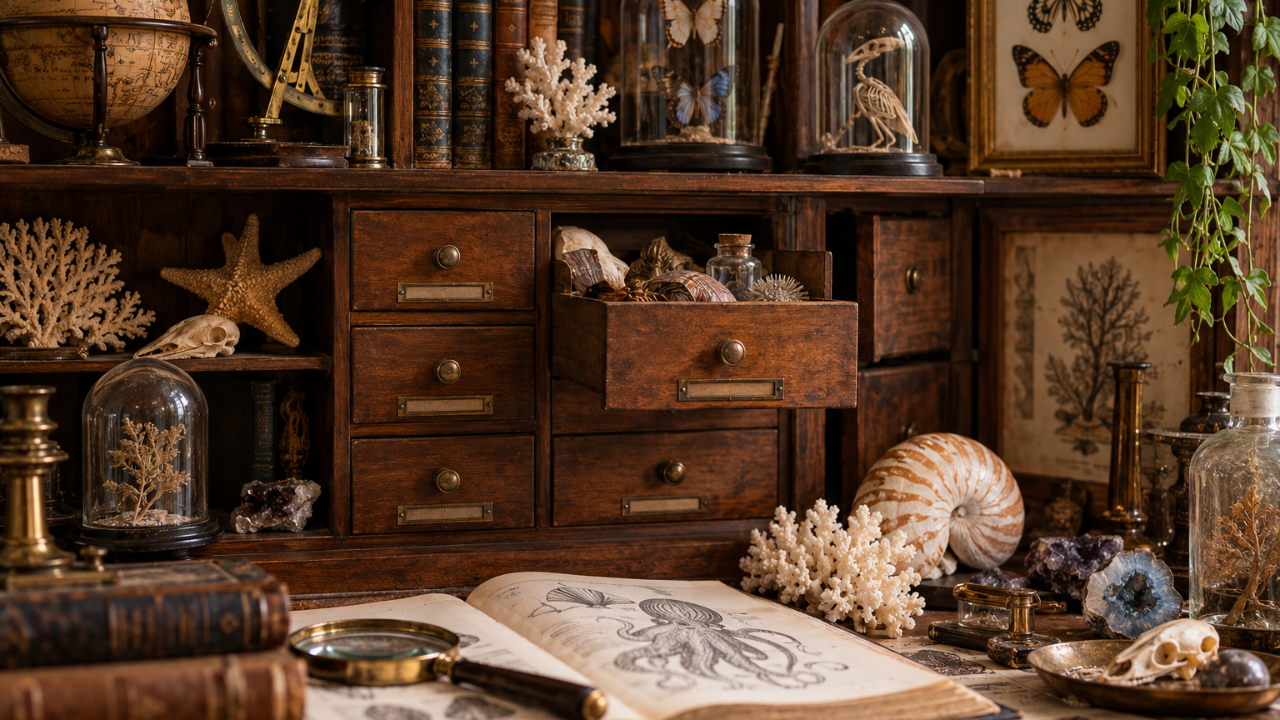
Imagine visiting someone's home in the 1600s.
They invite you into a room filled with beautiful wooden cabinets, crowded shelves, and objects you've never seen before. There are seashells from distant shores, strange fossils, elaborate scientific instruments, and perhaps a few creatures preserved in jars.
You look up.
There's a crocodile hanging from the ceiling.
Naturally.
Your host proudly shows you a collection of unusual stones, an intricately carved ivory object, and something they insist is the horn of a unicorn.
And the really wonderful part?
This isn't an imaginary scene. People actually collected things like this.
Welcome to the wonderfully peculiar world of curiosity cabinets.
A Room Full of Wonder
Beginning in Renaissance Europe, particularly during the 1500s and 1600s, wealthy collectors, scholars, physicians, and naturalists began assembling extraordinary collections of objects.
These collections became known as cabinets of curiosities, or Wunderkammern.
The German word Wunderkammer translates roughly to room of wonder, which might be one of my favorite names for a room ever invented.
And despite the word cabinet, these weren't necessarily pieces of furniture. Some were elaborate cupboards filled with tiny compartments and hidden drawers. Others occupied entire rooms.
Their contents were gloriously eclectic.
You might find a beautiful piece of coral sitting beside an ancient coin. A scientific instrument might share a shelf with a preserved animal. Rare minerals, unusual plants, intricate artwork, and objects brought from distant places all found their way into these collections.
Today, we tend to separate things into categories. Natural history belongs in one museum, art in another, and scientific instruments somewhere else entirely.
But curiosity cabinets weren't particularly interested in those boundaries.
They were attempts to gather the astonishing variety of the world into one place.
And apparently, the world had quite a lot to offer.
The Crocodile on the Ceiling
One of the most famous early collections belonged to Ferrante Imperato, an Italian apothecary and naturalist living in Naples.
In 1599, Imperato published a book about natural history that included an illustration of his remarkable collection.
And there it is, right in the picture.
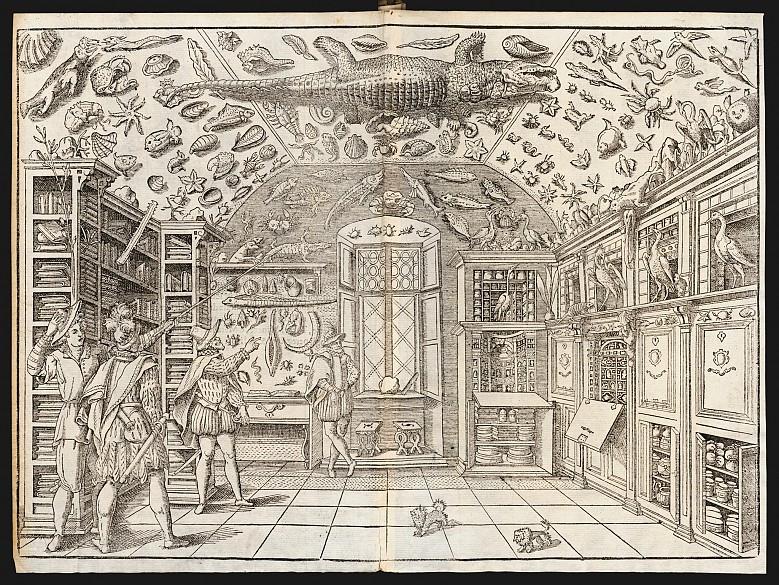
A crocodile suspended from the ceiling.
Around it, the walls are covered with specimens. Shelves overflow with books and objects, and visitors examine the collection with the sort of attention usually reserved for something truly extraordinary.
I find this image fascinating because it captures a particular kind of enthusiasm.
Imperato wasn't content to read about the natural world. He wanted to collect pieces of it, examine them, compare them, and share them with other curious people.
His collection wasn't simply decorative. It was also a place of observation and study.
Although I do wonder how one decides that the ceiling is the appropriate place for a crocodile.
Like, was there a discussion about this? Did someone suggest a smaller shelf?
I have questions.
The Unicorn Horn Problem
Of course, not everything in these collections was quite what people believed it to be.
One particularly prized curiosity was the supposed horn of a unicorn.
For centuries, Europeans traded and collected long, spiraling tusks that were believed to possess extraordinary properties. Some people thought they could protect against poison or cure illnesses.
The objects themselves were real, though the unicorn explanation was a little less reliable.
Many of these prized horns were actually narwhal tusks.
Which, if you ask me, is almost more interesting.
Somewhere in the Arctic Ocean, there's a whale with a long, spiraling tooth projecting from its head.
That's an actual animal. We don't even need to invent a mythical horse.
Anyhoo.
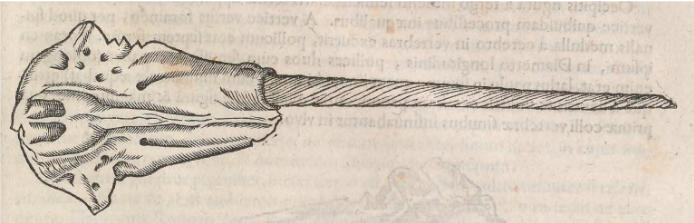
Danish scholar Ole Worm, who maintained his own famous collection in the seventeenth century, helped establish the connection between supposed unicorn horns and narwhals.
There's something absolutely delightful about this particular historical misunderstanding.
People encountered something extraordinary and tried to explain it using the knowledge they had.
Sometimes they were wrong.
Sometimes they were spectacularly wrong.
But the object was still worth investigating.
Wonder didn't disappear when the explanation changed.
If anything, the truth gave people something even more fascinating to learn.
Some Cabinets Had Secrets
Now, here's a detail I particularly love.
Some curiosity cabinets were actual pieces of furniture with elaborate craftsmanship, concealed compartments, and hidden drawers.
Look at this beautiful wooden cabinet covered in carvings and decorative details. You open one drawer and discover a collection of tiny objects. Behind another panel, there's a compartment you didn't even realize existed.
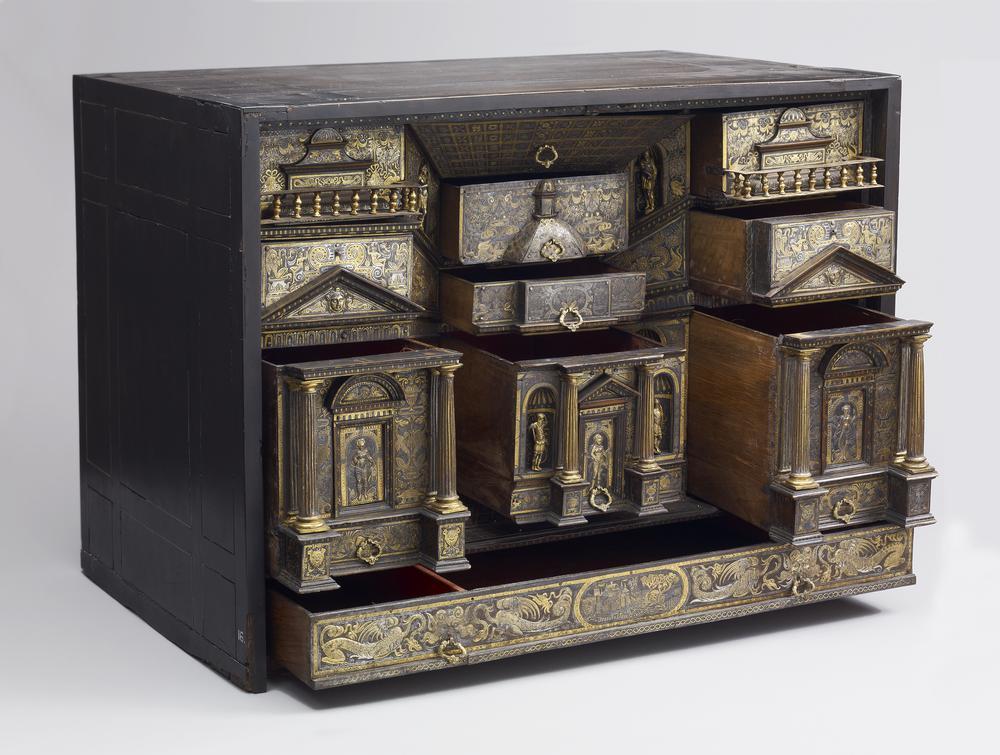
The furniture itself becomes part of the mystery.
Collectors could arrange their treasures in ways that invited visitors to explore, discover, and occasionally be surprised.
And because many cabinets were personal collections, their contents reflected the particular interests of their owners.
One collector might be fascinated by shells and minerals. Another might prefer mechanical inventions, ancient artifacts, or unusual works of art.
There wasn't a single correct way to be curious.
Although having enough money to acquire an entire roomful of rare objects certainly helped.
Which brings us to a less whimsical part of the story.
There Was Another Side to All This Wonder
As charming as these collections can seem today, their history wasn't entirely innocent.
Many were assembled by European rulers and wealthy collectors during an era of expanding trade, colonization, and unequal power.
Objects arrived through complicated networks of exchange, and some were acquired through exploitation or coercion.
Collections could also be displays of wealth and authority. Owning rare objects from distant places was a way of demonstrating how far someone's influence reached.
And the people whose cultures, lands, and knowledge made those objects possible weren't always acknowledged or represented fairly.
It's worth remembering that alongside the wonder.
Because curiosity can lead to extraordinary discoveries, but it doesn't automatically make the way we pursue those discoveries thoughtful or respectful.
I think the most interesting history is often the kind that allows us to appreciate something while still asking difficult questions about it.
From Private Collections to Public Museums
Over time, the way people collected and organized knowledge began to change.
Scientific classification became more systematic. Collections grew, institutions developed, and objects that had once been displayed together began finding homes in more specialized settings.
Natural history specimens moved toward natural history museums. Artwork became part of art collections. Scientific instruments were studied and preserved in their own right.
The old curiosity cabinets helped lay the groundwork for many of these developments.
In a way, they were early attempts to build a miniature version of the world.
Not necessarily an accurate one.
Certainly not a complete one.
But one filled with questions.
- What is this?
- Where did it come from?
- How does it work?
- What else is out there?
And perhaps most importantly:
What haven't we discovered yet?
Why I Love the Idea of a Curiosity Cabinet
There's something about these collections that I find completely irresistible.
Not the wealth or the status symbols. And preferably not the questionable methods of acquiring things.
It's the idea of giving interesting things a place to belong.
A seashell doesn't need to explain why it's sitting beside a telescope. An unusual fossil doesn't have to become more useful than a beautiful piece of artwork.
They're different kinds of wonderful.
And someone thought they were all worth keeping.
I think that's part of why I wanted to call this little corner of Lift & Shift Life The Curiosity Cabinet.
I wanted a place where we could explore fascinating ideas without requiring every one of them to lead to a practical outcome.
Some articles might explore history. Others might wander into architecture, nature, psychology, or an obscure question that seemed perfectly reasonable to investigate at eleven o'clock on a Tuesday.
There will probably be a few experiments.
Possibly some unexpected connections.
And almost certainly the occasional rabbit hole that gets wildly out of hand.
But that's rather the point.
Because the world is full of extraordinary things, and I don't think we need to justify being interested in them.
Sometimes we can simply open a drawer, find something fascinating, and enjoy the discovery.
Welcome to The Curiosity Cabinet.
I'm so glad you're here.
Now, shall we see what's in the next drawer? 💛