
The Problem With Solving Problems
Oct 19, 2026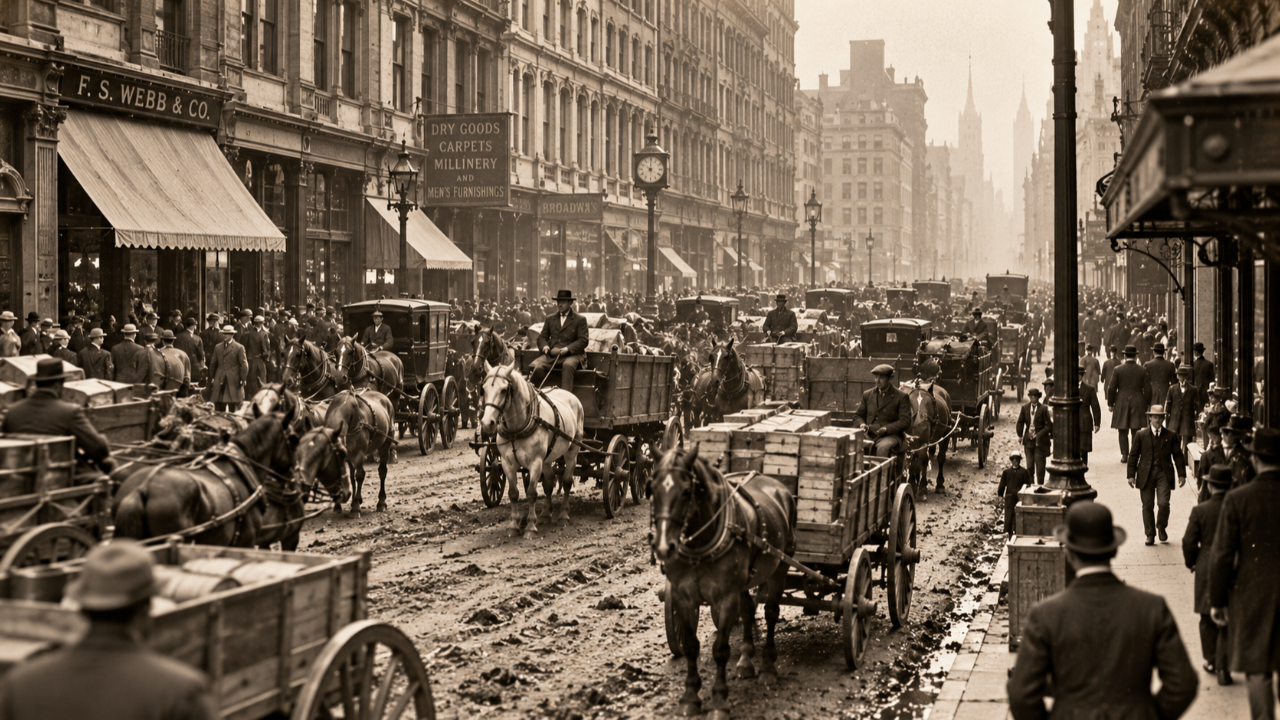
Imagine you're living in New York City in the year 1900.
You step outside your front door, ready for a perfectly ordinary Tuesday.
A horse-drawn carriage rattles past. Another horse pulls a delivery wagon loaded with goods. Somewhere nearby, several more horses are hauling passengers through the streets.
It's busy. It's noisy. It's bustling with modern urban life.
And it smells absolutely terrible.
Because there is one rather significant problem with building an entire transportation system around horses.
Horses poop.
A lot.
And at the turn of the twentieth century, cities were discovering that the consequences of this particular biological function were becoming rather difficult to manage.
Then along came a remarkable invention that promised to help clean up the streets.
The automobile.
Yes.
The automobile.
The machine we now associate with exhaust fumes, traffic congestion, and climate change was once promoted as a cleaner alternative to the transportation system it replaced.
Which raises a fascinating question:
How does yesterday's brilliant solution become tomorrow's enormous problem?
And perhaps more importantly, how can we recognize when we're doing the same thing today?
The Problem With Having Three Million Horses
Let's begin with some numbers. Numbers can be fun!
According to the Smithsonian's National Museum of American History, more than three million horses worked in American cities around 1900.
Together, they produced approximately 30,000 tons of manure every day.
Thirty. Thousand. Tons.
Daily.
I feel like that number deserves a moment of silence (and perhaps a certain Jurassic Park quote).
A typical city horse could produce dozens of pounds of manure and substantial quantities of urine each day.
Now imagine thousands upon thousands of these animals moving through crowded streets.
They weren't simply decorative creatures pulling the occasional romantic carriage.
They were the engines of the urban economy.
Horses transported people, delivered food, hauled construction materials, and moved merchandise between businesses.
They were essential. And so was dealing with what they left behind.
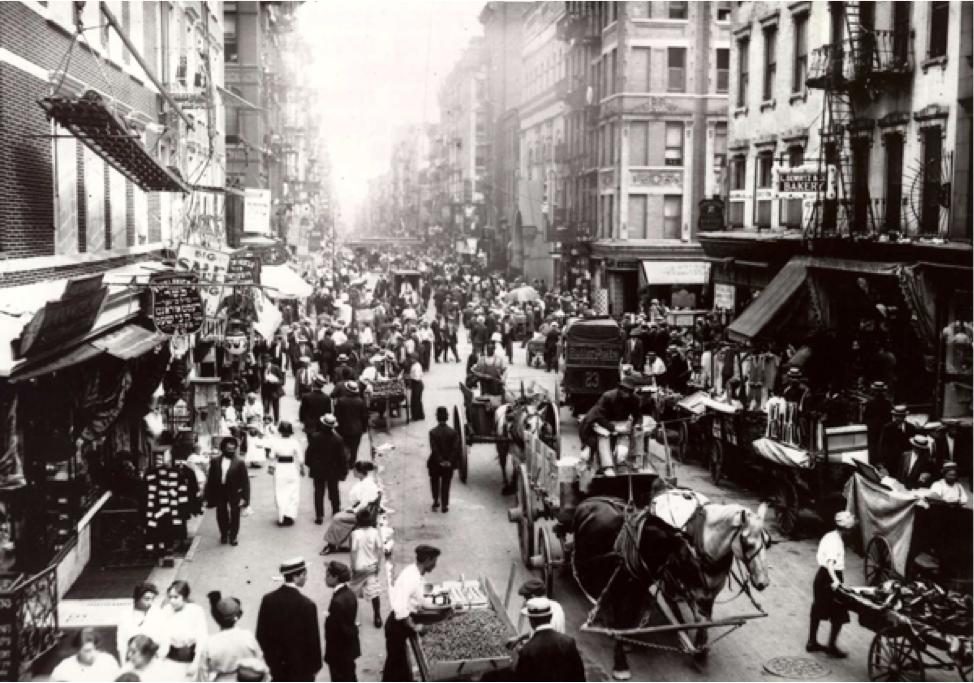
Cities employed workers to clean streets and remove waste. Manure could sometimes be sold for agricultural use, but collecting, transporting, and disposing of enormous quantities was an ongoing challenge.
In dry weather, waste could contribute to dust.
In wet weather, it mixed with mud.
And in warm weather?
Well.
Let's just say Victorian summers weren't necessarily improved by opening a window.
There were also LOTS of flies.
Horse manure provided breeding opportunities for insects, including houseflies, which could carry disease-causing organisms between contaminated material and human environments.
The problem wasn't merely unpleasant.
It had genuine public-health implications.
And we haven't even discussed the dead horses yet.
Unfortunately, the Horses Also Died
Here's a particularly grim detail that tends to get left out of nostalgic depictions of horse-drawn cities.
Urban working horses had difficult lives.
They hauled heavy loads, navigated crowded streets, and sometimes suffered injuries or exhaustion.
When a horse died in the street, removing an animal that might weigh more than a thousand pounds was no small undertaking.
According to the American Museum of Natural History, approximately 130,000 horses worked in Manhattan alone in 1900.
And historical accounts describe the enormous logistical challenge of removing dead animals from city streets.
Some cities collected thousands of horse carcasses annually...
We started this article with horse manure, and somehow things have gotten worse.
But there's an important reason to understand these details.
When we imagine the past, we tend to remember its most charming features.
The elegant carriages.
The cobblestone streets.
The beautiful old buildings.
We don't usually imagine the smell, the sanitation workers, the flies, or the exhausting labor required to keep everything functioning.
History looks considerably more romantic when nobody includes the waste-management department.
And this matters because, without understanding the problems people were living with, their enthusiasm for what came next can seem rather strange.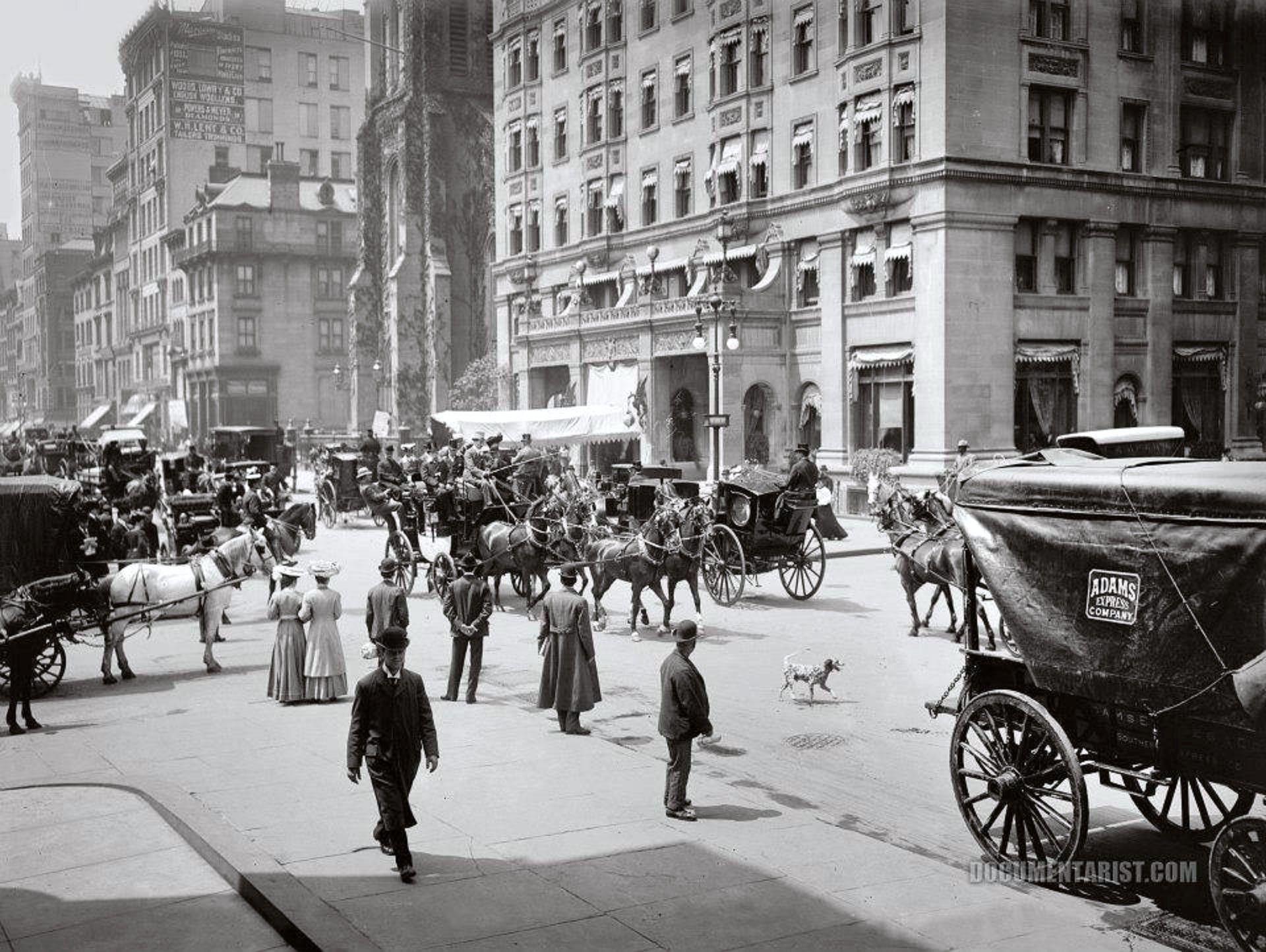
Enter the Horseless Carriage
Now imagine you're a city resident watching an early automobile drive down the street.
It's noisy.
It's expensive.
It might break down.
And depending on the model, it may be a little terrifying.
But it has one rather extraordinary advantage.
It doesn't leave manure behind.
- No stable required.
- No daily feeding.
- No enormous piles of waste accumulating along busy roads.
- No horse collapsing halfway through a delivery.
For people struggling with the consequences of horse-powered transportation, this was a genuinely exciting possibility.
Motor vehicles were promoted partly as a way to address urban sanitation problems.
And automobiles weren't the only innovation changing transportation. Electric streetcars had already begun replacing horse-drawn transit in many cities, while bicycles and other technologies were reshaping how people traveled.
The transition was complicated, gradual, and driven by far more than cleanliness.
But the appeal of escaping the horse problem was real.
Think about that for a moment.
A machine powered by fossil fuels could seem like a major environmental improvement because people were comparing it with streets full of animal waste.
And in that specific respect?
They weren't wrong.
That's what makes this story so interesting.
The automobile didn't have to be environmentally harmless to solve a genuine environmental problem.
It just had to be better at addressing the problem people were most desperate to escape.
The Nine-Foot Mountain of Manure That Probably Never Existed
Before we go any further, we need to discuss one of my favorite historical exaggerations.
You may have encountered a story about something called the Great Horse Manure Crisis of 1894.
According to the popular version, someone writing for The Times of London predicted that within fifty years, the city's streets would be buried beneath nine feet of horse manure.
Nine feet.
Imagine opening your front door and discovering that the street has become the smelliest archaeological excavation.
The story is frequently used to illustrate how technological breakthroughs can solve problems that seem impossible.
There's just one small issue.
Historians have struggled to verify that the famous prediction was ever made.
The specific newspaper statement has not been reliably established, despite its frequent repetition.
Which is wonderfully ironic.
A story about how people failed to predict the future became popular partly because we didn't investigate its own past carefully enough.
To be clear, London's horse-manure problem was real.
Historian Lee Jackson has documented the extraordinary filth of Victorian London, including streets coated in mud containing substantial quantities of horse dung.
But we don't need an imaginary nine-foot mountain to appreciate the scale of the problem.
The real history is strange enough.
And I think there's something rather fitting about discovering a questionable historical claim in the middle of an article about the dangers of assuming we understand things.
The manure has layers. Apparently, so does the irony.
The Solution That Created a Different Problem
Fast-forward a century.
The horse-drawn city has largely disappeared.
Automobiles, buses, trucks, and electric transit have transformed how people move.
We no longer need millions of working horses to transport goods and passengers through urban streets.
And we certainly don't have to remove 30,000 tons of horse manure from American cities every morning.
That's an enormous achievement.
But now we have other problems.
- Vehicle exhaust contributes to air pollution.
- Transportation produces greenhouse gas emissions.
- Roads and parking areas occupy enormous amounts of urban land.
- Traffic congestion wastes time, and vehicle collisions cause injuries and deaths.
We've solved many problems associated with horse-powered transportation.
And created or expanded an entirely different collection of problems.
It's tempting to look backward and laugh.
How could they possibly have thought cars were environmentally friendly?
But that's not a particularly fair question.
They were responding to the world they knew.
The better question is:
What are we celebrating today because it solves a problem we can see, while overlooking problems we haven't learned to recognize yet?
That's a much less comfortable question.
Which is usually a sign that we've found an interesting one.
Every Solution Has a Shadow
Here's a concept worth keeping in your back pocket.
When we solve a problem, we often evaluate the solution against whatever came before it.
And that makes perfect sense.
If your city is drowning in horse manure, a vehicle that doesn't produce manure looks wonderful.
If a new invention saves hours of labor, you naturally appreciate the time it returns.
If a technology makes something dramatically cheaper or more accessible, its benefits can be enormous.
But there's a difference between asking:
Does this solve our current problem?
And asking:
What happens if millions of people begin using this for the next hundred years?
The second question is much harder.
Not because people are foolish, but because technologies don't exist in isolation.
They change behavior. They reshape cities.
They influence what businesses build, what governments regulate, and what people come to consider normal.
An automobile doesn't merely replace a horse.
Once automobiles become widespread, cities begin building infrastructure around them.
Roads widen. Parking lots appear. Neighborhoods spread outward. Daily travel patterns change.
The solution becomes part of a much larger system.
And eventually, the system creates problems of its own.
There's a name for some of these unexpected consequences: unintended consequences. Wow.
Not every consequence is entirely unpredictable, of course. People raised concerns about automobile dangers and pollution long before those problems reached their modern scale.
But it can be remarkably difficult to understand how a promising innovation will behave once it's adopted everywhere.
Especially when we're understandably excited about the problem it just solved.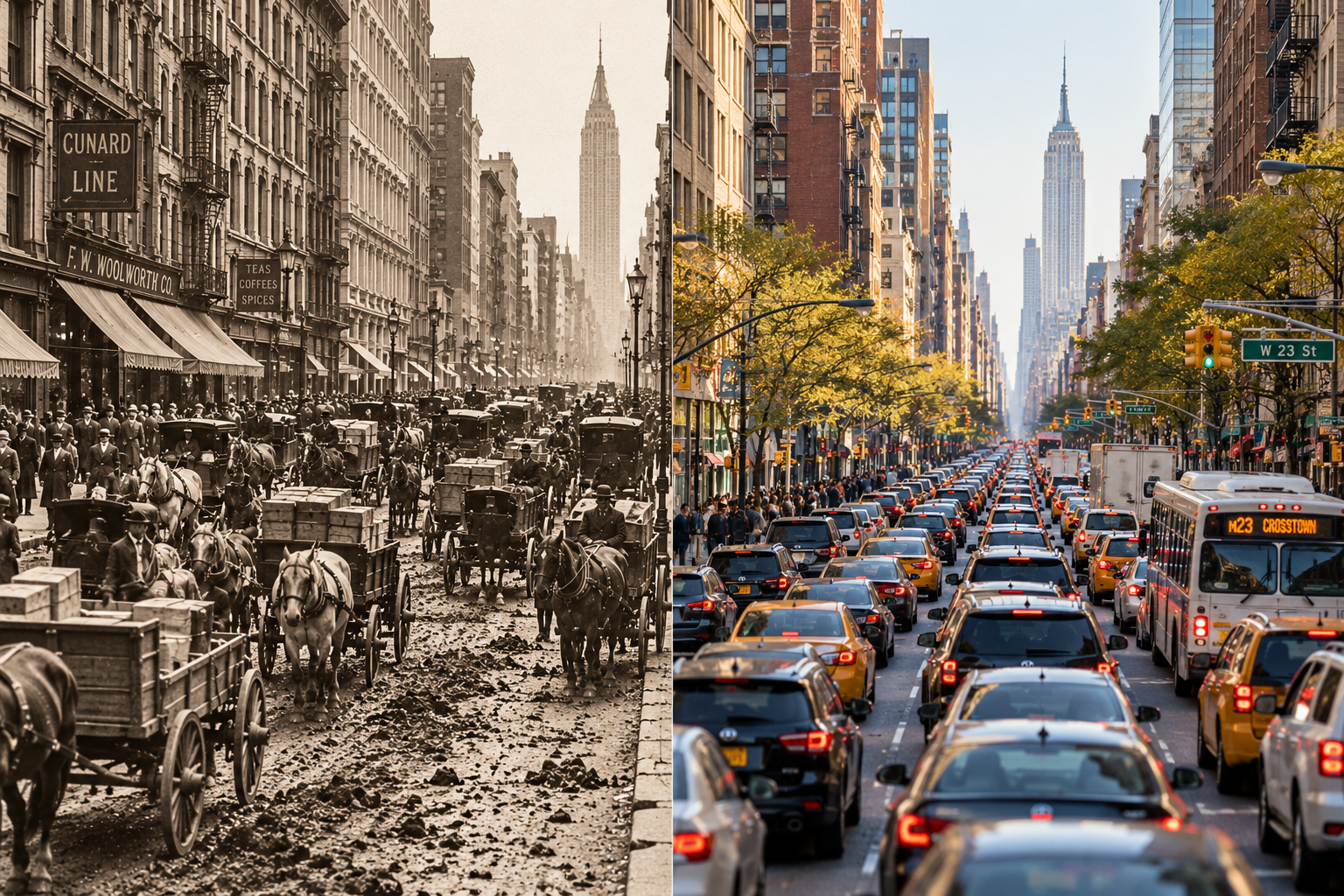
(illustrative reconstruction)
The Question Nobody Thinks to Ask
Here's what I find most fascinating about this entire story.
The automobile wasn't a foolish solution to an imaginary problem.
The problem was real. The benefits were real. And the people who welcomed a world with fewer working horses had some excellent reasons for doing so.
The trouble wasn't necessarily that they chose the wrong solution.
It was that solving one problem changed the conditions under which everyone would make their next decisions.
And their next decisions. And the next ones after that.
Eventually, entire cities were organized around a technology that had once seemed like a relatively straightforward improvement.
Which makes me wonder how many things in our own lives are the result of a similar chain of perfectly reasonable decisions.
Not necessarily bad decisions.
Just decisions whose consequences became clearer over time.
So here's something worth trying the next time you encounter an exciting new solution, whether it's a technology, a business idea, or simply a clever way to make your Tuesday less complicated.
Ask three questions.
1. What problem does this actually solve?
Be specific. A solution can be wonderful at fixing one thing without fixing everything around it.
2. What happens if this works really well?
Not if it fails. If it succeeds spectacularly.
What happens when everyone uses it? When you depend on it? When other parts of your life begin adapting around it?
Sometimes success changes the situation more dramatically than failure ever could.
3. And what might I be trading away?
Maybe nothing terribly important.
Maybe something you're perfectly happy to exchange.
Or maybe there's a cost you hadn't considered because you were understandably distracted by how wonderful the solution looked.
You won't always have complete answers.
Neither did the people standing in those manure-covered streets.
But asking the questions gives you a better chance of understanding what you're choosing.
And here's the part I particularly like:
You don't have to become suspicious of every good idea to become more thoughtful about its consequences.
Progress doesn't require perfection.
It requires curiosity, a willingness to reconsider, and occasionally the humility to admit that our brilliant solution has developed a rather unexpected side effect.
After all, we didn't solve the horse manure problem by refusing to invent anything new.
We solved it by changing how we moved through the world.
And now we're working on changing that system again.
Perhaps that's what progress actually looks like.
Not finding one perfect solution that lasts forever.
But getting better at noticing what needs to change next.
And if the next great transportation revolution manages to reduce emissions, improve our cities, and avoid producing thirty thousand tons of manure every day?
I'd call that a pretty respectable improvement.