
How to Learn Everything Without Losing Your Mind
Feb 03, 2026
Picture this with me, okay?
I'll bet that some days it feels like your brain is a jigsaw puzzle with 100 missing pieces — and every piece is a skill you want to learn. Sound familiiar?
You jump from painting to coding to writing to music, and somewhere in the middle, you feel your focus fray.
You need to understand: your brain isn’t broken (yay), but your system is missing (uh-oh).
Multipassionates aren’t made for linear skill-building. We’re made for layered learning, where one skill feeds another — but only if you structure it intentionally and in a strategic way. Otherwise, we end up spinning, exhausted, and frustrated.
············································································································································
Why Multipassionates Struggle With Learning
Traditional learning advice assumes:
-
Mastery in one subject at a time
-
Consistent repetition in the same skill
-
Linear skill progression
But multipassionates’ brains are pattern-seeking, novelty-driven, and fast at cross-connection. When forced into linear learning:
-
Interest fizzles quickly
-
Skills remain shallow
-
Momentum collapses
The secret? Stacking skills strategically so each new thing compounds instead of competing.
············································································································································
Ways to Stack Skills Without Burnout
1. Identify Your Transferable Skills
Some skills naturally feed others:
-
Writing + research → blogging, scripting, storytelling
-
Drawing + photography → visual storytelling, design
-
Coding + analytics → data visualization, app design
Mapping these connections turns “too many skills” into a growth ecosystem.- If you're struggling with ways to do this, put a list of your top skills/interests into ChatGPT and ask how you could combine some of them, or use any 2 to feed into others.
2. Layer Learning by Depth, Not Breadth
Instead of trying to “master everything” at once:
-
Pick one skill for deep weekly focus (e.g., 1–2 micro-projects)
-
Rotate complementary skills in smaller doses (10–30 minutes/day)
-
Over time, even mini sessions compound, creating unexpected cross-skill breakthroughs.
3. Micro-Projects That Fuse Skills
-
Combine compatible skills in small experiments:
-
Example: Write a blog post while creating a graphic or sketch for it
-
Example: Record a mini-podcast while learning music production
-
-
These experiments reinforce multiple skills simultaneously without feeling like extra work.
4. The “Reverse Learning” Technique
-
Start with the output you want, not the skill steps.
-
Example: Want to design a website? Don’t just learn HTML — try building a 1-page site immediately, then research gaps as they arise.
Look at this graphic by GrowthbyVisuals: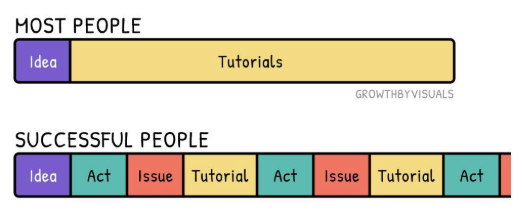
-
This aligns SO WELL with multipassionate brains: learning by doing + curiosity-driven exploration.
5. Track Skill Evolution, Not Just Completion
-
Traditional progress metrics fail multipassionates. Instead, track:
-
Insights gained
-
Mistakes made
-
Connections formed between skills
-
-
Seeing this invisible growth reinforces confidence and prevents “I’m behind” panic.
············································································································································
Please Please Remember:
Your brain is a skill ecosystem, not a checklist.
-
Every new skill you explore adds nutrients to the others
-
Every mini-project compounds into long-term growth
-
Depth and breadth can coexist — but only if you intentionally layer them
Instead of fearing your brain’s variety, trust it as your greatest learning tool.
You’re not scattered. You’re building an interconnected toolkit that will serve every passion you pursue.
And I'm so SO proud of you,